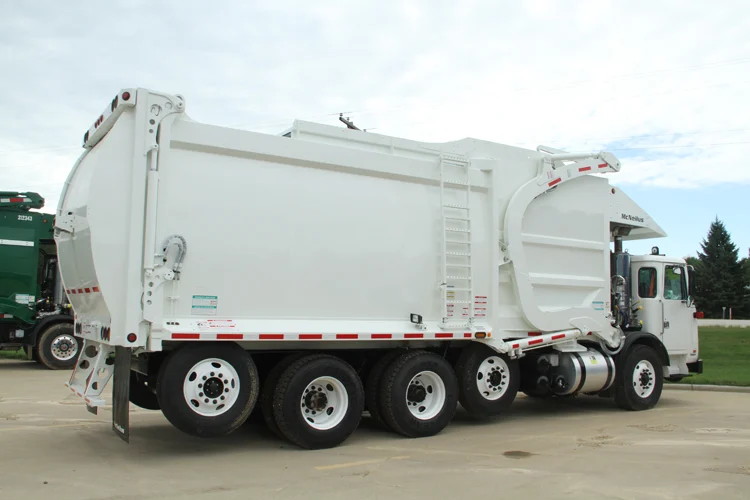
Understanding mcneilus front loader configurations
Front-loading refuse trucks are built for repeated commercial-container collection, but different routes require different combinations of capacity, payload, lift capability, and manoeuvrability. A fleet should evaluate the entire operating environment before selecting a model, including container sizes, access conditions, material density, disposal distance, and chassis requirements.
Fleet operators looking for dependable refuse collection equipment can consider a McNeilus front loader. Atlantic Heavy Duty features Atlantic Series and Meridian models designed for demanding commercial and residential collection routes.
How Front Loaders Work
A front loader uses lifting arms to raise compatible containers over the cab and empty them into the body hopper. The material is then compacted to make efficient use of available capacity.
This design allows a trained driver to service many commercial containers from inside the cab, depending on route and site conditions. The operation still requires careful positioning and attention to overhead clearance, pedestrians, vehicles, and surrounding structures.
Container compatibility and safe access should be confirmed during route planning.
Atlantic Series Applications
The Atlantic Series is designed for demanding workloads where durability, capacity, and productivity are priorities. It can suit commercial collection routes involving frequent container lifts and heavy daily use.
Several body capacities allow the truck to be matched with route volume and chassis specifications. Fleet managers should avoid selecting capacity solely according to the largest available option.
Payload, local weight limits, disposal distance, and container material must all be considered.
Meridian Applications
The Meridian provides another configuration for commercial and residential collection. Its lighter-weight design may be relevant where payload efficiency and regulatory weight limits are important.
The model offers multiple body-capacity options and substantial arm-lift capability. Its suitability depends on the containers and materials used on the intended route.
A lighter body can create operational advantages, but fleet managers should compare durability, capacity, and route demands rather than considering weight in isolation.
Matching Capacity With Route Volume
Body capacity influences the number of disposal trips, vehicle weight, manoeuvrability, and chassis requirements.
A high-volume route may benefit from a larger body, but dense materials can cause the truck to reach its legal weight before using all available space. Lighter material may fill the body before the truck reaches its weight limit.
Historical scale tickets and route records can help identify whether the fleet is typically limited by volume or weight.
Evaluating Container Types
Commercial routes may include containers with different sizes, conditions, and loading characteristics. The front-loader arms and attachments must be compatible with the fleet’s container inventory.
Damaged or improperly positioned containers can create operational and safety problems. Collection sites should provide adequate space for the truck to approach, lift, and depart safely.
Fleet managers should inspect route containers before finalizing a new truck specification.
Hydraulic and Packing Systems
Hydraulic components perform repeated lifting and packing cycles throughout the working day. Reliability and contamination control are therefore essential.
McNeilus front loaders incorporate packing-cylinder and control technologies intended to support performance and diagnostics. Maintenance teams should review these systems and understand service procedures before delivery.
Hydraulic fluid condition, filters, hoses, fittings, cylinders, and controls require scheduled inspection.
Diagnostic Capabilities
Modern refuse vehicles increasingly use electronic controls to provide diagnostic and troubleshooting information. These systems can help technicians identify faults and reduce the time needed to locate certain problems.
Technology delivers value when maintenance teams are trained to use it. Fleet managers should confirm access to documentation, diagnostic tools, software support, and technical assistance.
Electronic information should complement regular physical inspection, not replace it.
Chassis Selection
The body must be paired with a suitable heavy-duty chassis. Important considerations include axle ratings, wheelbase, suspension, braking, engine output, transmission, cab visibility, and service support.
Front-loader routes involve frequent stops and repeated lifting cycles. The chassis specification must support these operational demands.
Local dealer coverage and parts access may influence long-term uptime, particularly for fleets operating far from major service facilities.
Driver Visibility
Commercial collection sites can contain parked vehicles, overhead wires, buildings, pedestrians, and restricted access points. Good visibility is critical.
Cameras, mirrors, lighting, and warning systems can support the driver, but safe operation still depends on training and route awareness.
Drivers should inspect the area before raising a container and remain alert to changing conditions.
Maintenance Planning
A refuse truck should enter service with a preventive-maintenance plan. Daily inspections may cover fluid leaks, safety systems, lights, tyres, lifting components, and visible damage.
Scheduled maintenance should reflect hours, mileage, lift cycles, and operating severity. A vehicle completing frequent container lifts may require a different service approach from one accumulating primarily highway mileage.
Maintenance records can reveal recurring problems and support replacement planning.
Technician and Driver Training
Operators need training on controls, container approach, lift procedures, packing, warning systems, and emergency response.
Technicians require model-specific knowledge of hydraulic, electrical, structural, and control systems.
Training should be refreshed when equipment or procedures change. Consistent operation can reduce avoidable wear and safety risk.
Working With Atlantic Heavy Duty
Atlantic Heavy Duty presents multiple McNeilus front-loader configurations, including Atlantic Series and Meridian models. Buyers can discuss available capacities, chassis options, service support, parts, and current inventory.
Exact availability and delivery schedules should be confirmed directly. A detailed specification review can help ensure that the selected truck matches the route.
Final Thoughts
A front loader should be selected as a complete operating system rather than a body specification alone. Capacity, payload, container compatibility, hydraulics, controls, chassis, maintenance, and driver safety all contribute to performance.
Fleet operators that use route data and involve drivers, technicians, and managers in the evaluation are better positioned to choose equipment that supports reliable long-term collection.